
The market valuation of 1977 25-cent coins is based on technical striking characteristics and the rarity of the highest preservation grades.
This issue, following immediately after the US Bicentennial, marked the return to the standard reverse design featuring an eagle.
A comparison with modern series (e.g., "State Quarters" or "American Women") reveals significant differences in price formation mechanisms and growth rates.
1977 coins were struck at two primary facilities: Philadelphia and Denver.
Composition: Copper-nickel clad (75% copper and 25% nickel layer over a pure copper core).
Mass: 5.67 grams.
Diameter: 24.26 millimeters.
Philadelphia Mintage (No mark): 468,556,000 pcs.
Denver Mintage (D mark): 256,524,978 pcs.
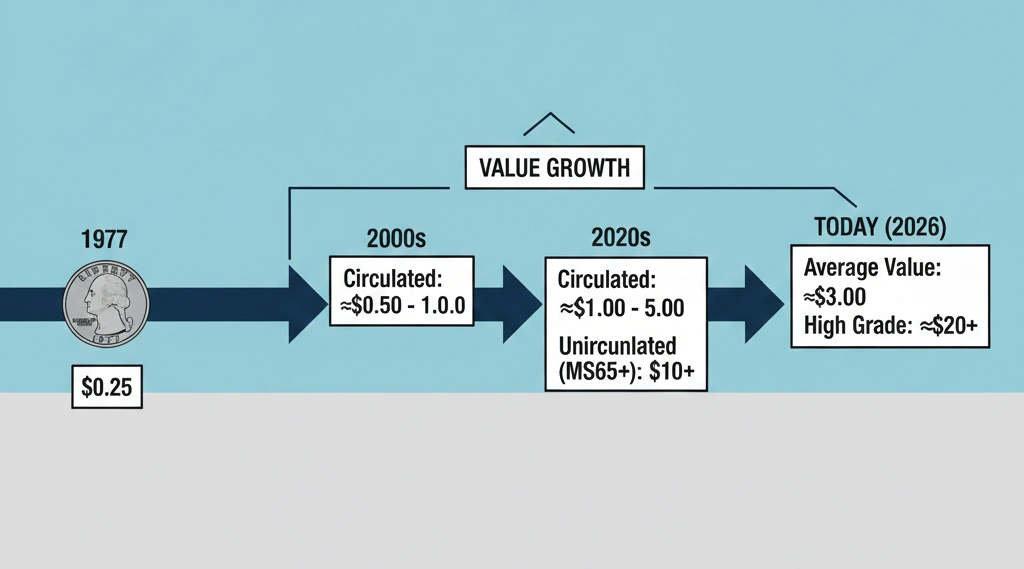
The 1977 quarter value demonstrates a sharp spike upon transitioning into the Mint State segment (MS66 and higher).
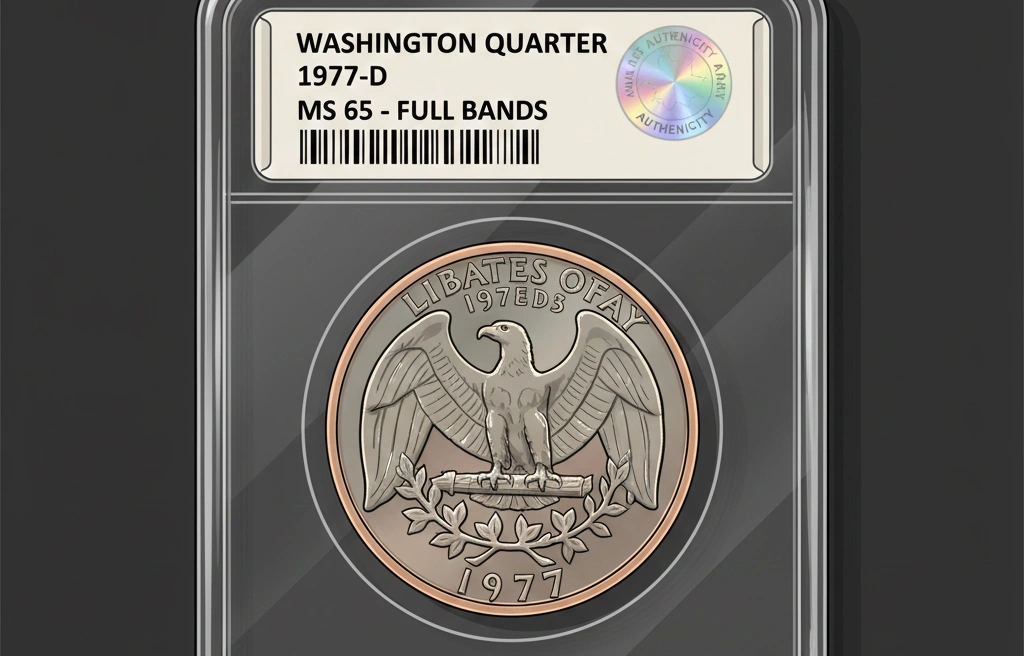
Most coins found in circulation are valued exclusively at face value due to the absence of numismatic scarcity.
Grading | 1977 (Philadelphia) | 1977-D (Denver) |
MS63 | 1.00 USD | 1.00 USD |
MS65 | 5.00 USD | 5.00 USD |
MS66 | 20.00 USD | 18.00 USD |
MS67 | 250.00 USD | 120.00 USD |
MS67+ | 1,250.00 USD | 600.00 USD |
The price gap between MS65 and MS67+ grades exceeds 20,000%, driven by the exponential decrease in the number of surviving specimens without damage.
Grading agency statistics show the presence of only a few dozen coins in MS67+ condition for the entire mintage volume.
Comparison with Modern Quarters (1999–Present)
Modern quarters, issued in the 50 State Quarters and American Women Quarters series, possess a different value structure.
The high value of modern coins is often associated with striking errors or low mintage at specific mints (e.g., West Point).
Mintage: Modern issues often feature a lower mintage for a specific design, reaching only 15–30 million specimens.
MS Grade Availability: Modern packaging technologies ensure better preservation of 2020s coins compared to 1977 samples.
Liquidity: Modern series possess a higher turnover rate on the secondary market due to mass interest in collecting sets.
A 1977 quarter in MS67 condition is more expensive than any standard 2024 quarter in a similar state due to the difficulty of finding an old coin without scratches.
Record Auction Prices
Historical sales data record extreme values for coins possessing a perfect surface and a sharp strike.
1977 (Philadelphia) MS67+: The record price reached 1,320 USD in 2021.
1977-D (Denver) MS67+: The record was fixed at 720 USD in 2023.
In comparison, a rare variety of a modern 2004 quarter (Wisconsin with leaf) can cost over 2,000 USD, but this is driven by a design error rather than grade rarity.
Market Value Change and Annual Yield
Price analysis for the 2015–2025 period reveals steady growth for the highest preservation categories of 1977 coins.
Average Annual Growth (MS67): 5.5%.
Price Volatility: Low, as auction supply is limited to the appearance of 1–2 new specimens per year.
Value Depreciation for Low Grades: A stable lack of growth related to market saturation with circulated coins.
Unlike the 1977 issue, modern quarters often lose 20–30% of their value in the first three years after release as the market becomes saturated with new graded slabs.
1977 Striking Errors
Searching for defects on 1977 coins is a separate field affecting the final price.
The following types of deviations are most frequently encountered:
Off-center strikes: Coins struck with more than 20% displacement are valued at 50–150 USD.
Die cracks: Found on the eagle or Washington’s portrait, adding 5 to 20 USD to the price.
Broadstrikes: Coins without a reeded edge having an increased diameter are valued at 20 to 40 USD.
Modern quality control standards at mints have significantly reduced the number of such errors, making older mistakes more valuable.
Impact of Proof Sets
In addition to circulation coins, Proof quality sets were issued in 1977 at the San Francisco Mint (S mark).
The set mintage reached 3,251,152 specimens.
1977-S Value (PR69 Deep Cameo): 10–15 USD.
1977-S Value (PR70 Deep Cameo): 40–80 USD.
The price for modern Proof sets (e.g., 2023 silver versions) is initially higher due to precious metal costs, a factor absent in standard 1977 issues.
Investment Potential and Liquidity
The liquidity of a 1977 quarter correlates directly with a certificate from a reputable company (PCGS or free coin identifier app).
Selling an uncertified coin through online platforms involves a 60% discount from the catalog price.
Investing in 1977 coins is advisable only when purchasing specimens with a grade higher than MS66.
For modern quarters, liquidity is supported by mass series, allowing for the rapid realization of even mid-range grades.
Physical Degradation and Corrosion
The condition of the copper-nickel layer of 1977 coins is susceptible to environmental influence, which is critical for long-term storage.
The appearance of dark spots or surface toning on 1970s coins is often perceived as a defect reducing the price.
In contrast, 21st-century modern quarters often exhibit rainbow patina, which can add 10–15% to the value under certain conditions.
Differences in blank cleaning technology explain the varying metal reactions to oxidation.
Parameter | 1977 Quarter | Modern Quarter (2020+) |
Primary Price Driver | Grade rarity (condition) | Mintage rarity/errors |
Price Stability | High | Moderate (trend dependent) |
Circulation Availability | High | Maximum |
Investor Entry Point | 100+ USD (for MS67) | 20+ USD |
The 1977 quarter remains an asset whose value is concentrated in the narrow segment of perfect preservation — you can easily check it with the coin value app.
Its value in the highest grading categories significantly exceeds the value of standard modern issues.
However, modern series offer greater variety for collecting due to unique designs absent in 1977.
Methodical study of every 1977 coin for the absence of micro-scratches allows for identifying specimens possessing an annual growth potential of 10–15% upon fixing the condition in independent laboratories.